
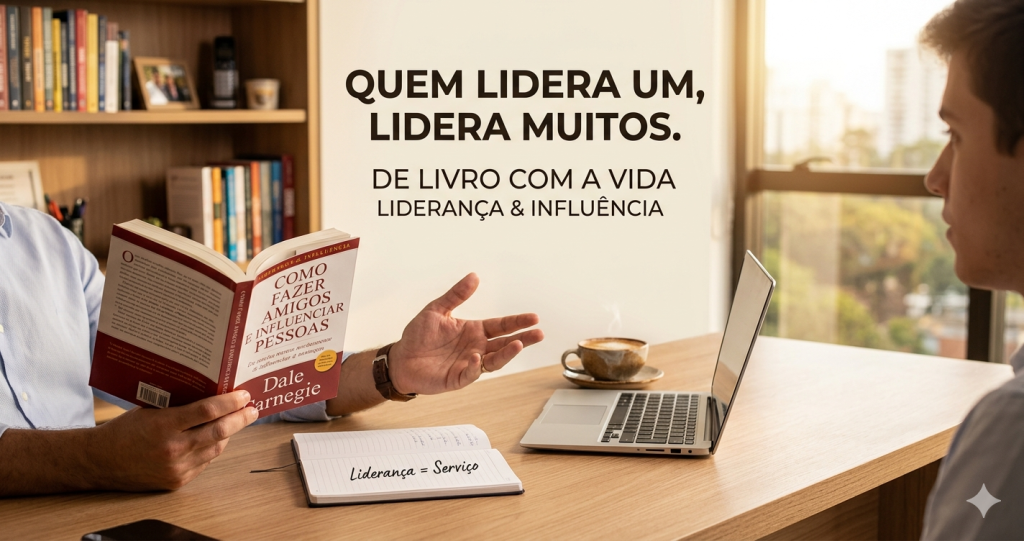
In common understanding, leadership is frequently confused with titles, positions, or hierarchical power. Yet true leadership is a human skill rooted in influence and service. At De Livro com a Vida, we believe that no one earns the right to lead others without first proving they can lead themselves.
In this pillar, we explore literature that goes beyond spreadsheets and processes. We investigate what makes a group of people choose to follow someone — even when there is no formal obligation to do so. Leadership here is understood as integral development: technical, emotional, and above all, human.
The Language of People in a Binary World
Coming from a technical background in IT — where logic is absolute and problems are solved with code and processes — the transition to people management can come as a shock. I learned early on that human beings are not binary. A team conflict cannot be resolved with a system “reboot.”
At 16, I encountered a book that would become one of the cornerstones of my life: How to Win Friends and Influence People, by Dale Carnegie. That learning allowed me to navigate rigid corporate environments and handle complex personalities, understanding that empathy and active listening are tools as powerful as any technical certification. At its core, leading is about understanding people.
Self-Leadership: Life’s Risk Management Strategy
There is a myth that a leader must always have life perfectly under control. The reality is that life is a seesaw — we have no control over death, global crises, or market instability. As in financial markets, absolute stability is an illusion.
However, the pursuit of self-improvement and personal development functions as a risk management strategy. By seeking stability through continuous reading and study, we do not eliminate hardship — but we drastically reduce the chances of failing through negligence. A team’s respect is earned when they realize their leader is on a growth journey just as demanding as the one they ask of those they lead.
The Difference Between Hierarchy and Natural Leadership
Throughout my career, I have led teams in technical offices and digital communities with over 40,000 people. Many ask me about the difference between those levels of leadership, and my answer is always the same: whoever can lead one can lead many. The scale changes, but the essence remains.
The key distinction lies between imposed leadership and earned leadership:
- Leadership by Hierarchy: Guaranteed by the organizational chart. People comply out of obligation and necessity — rarely out of inspiration. When leadership lacks legitimacy, the team perceives it, and the environment deteriorates.
- Leadership by Influence: What happens on the internet or in voluntary communities. Here, the follower chooses their leader. No contract obliges anyone to follow a content creator or mentor. Without moral authority and consistency by example, influence dissolves.
What You Will Find in This Leadership Pillar
In this category, we curate works that help build this natural authority. We cover:
- Assertive Communication: How to express ideas and manage conflict with clarity.
- High-Performance Team Management: Delegating with confidence and developing talent.
- Ethics and Character in Leadership: Building trust as a long-term asset.
- Social Psychology: Understanding the triggers of ethical influence and persuasion.
Leading is a continuous exercise in humility and learning. Every book we analyze in this pillar serves as a rung on the ladder — moving you from the role of boss to the role of guide.